



Research on the Influencing Factors of the Effectiveness of Collaborative Education between Ideological and Political Theory Course Teachers and Counselors in Universities
-
摘要: 高校思想政治理论课教师与辅导员协同育人是深化思想政治理论课与日常思想政治教育融合的战略举措,也是推动高校思想政治教育一体化的关键环节。为深入探究并厘清两支队伍协同育人成效的影响因素,突破协同配合壁垒,优化协同运行机制,文章面向全国86所高校的246名思政课教师、269名辅导员展开了问卷调研,通过分层回归分析方法检验了两支队伍协同育人成效的影响因素。研究发现思政课教师与辅导员协同育人的整体水平较高,两支队伍在育人实践中呈现出个性化特征,协同育人各维度水平在性别、年龄、院校层次、交流频率以及平台搭建中均存在显著差异。同时,育人能力、职能定位、协同意愿、育人方法和制度环境是影响育人成效的主要因素。基于此,建议改革育人制度体系,推进思政教育与人才培养深度融合;构建智慧思政平台,优化沟通机制;精准界定辅导员职能,强化身份认同;深度洞察教师差异,激发协同动力,实现协同育人效果质的飞跃与长足发展。
-
关键词:
- 高校思想政治理论课教师 /
- 辅导员 /
- 协同育人 /
- 影响因素
Abstract: Collaborative education between ideological and political theory course teachers and counselors in universities serves as a strategic measure to deepen the integration of ideological and political theory courses with daily ideological and political education, and also acts as a key link in advancing the integration of ideological and political education in universities. To thoroughly explore and clarify the influencing factors of the effectiveness of collaborative education of the two groups, break down coordination barriers and optimize collaborative operation mechanisms, this study conducted a questionnaire survey among 246 ideological and political theory course teachers and 269 counselors from 86 universities nationwide, and adopted hierarchical regression analysis to test the influencing factors of the effectiveness of collaborative education of the two groups. The results show that the overall level of collaborative education between ideological and political theory course teachers and counselors is favorable. Both groups exhibit distinct characteristics in their educational practices, and the levels of various dimensions of collaborative education show significant differences in terms of gender, age, institutional level, communication frequency and platform construction. Meanwhile, educational capability, functional positioning, willingness to collaborate, educational methods and institutional environment are identified as key factors influencing the effectiveness of collaborative education. Based on these results, recommendations are proposed: reforming the educational institutional system to deepen the integration of ideological and political education with talent cultivation; constructing smart ideological and political platforms to optimize communication mechanisms; precisely defining the functions of counselors to strengthen identity recognition; and deeply understanding teachers’ differences to stimulate motivation for collaboration. These measures aim to achieve qualitative improvements and sustained development in collaborative education outcomes. -
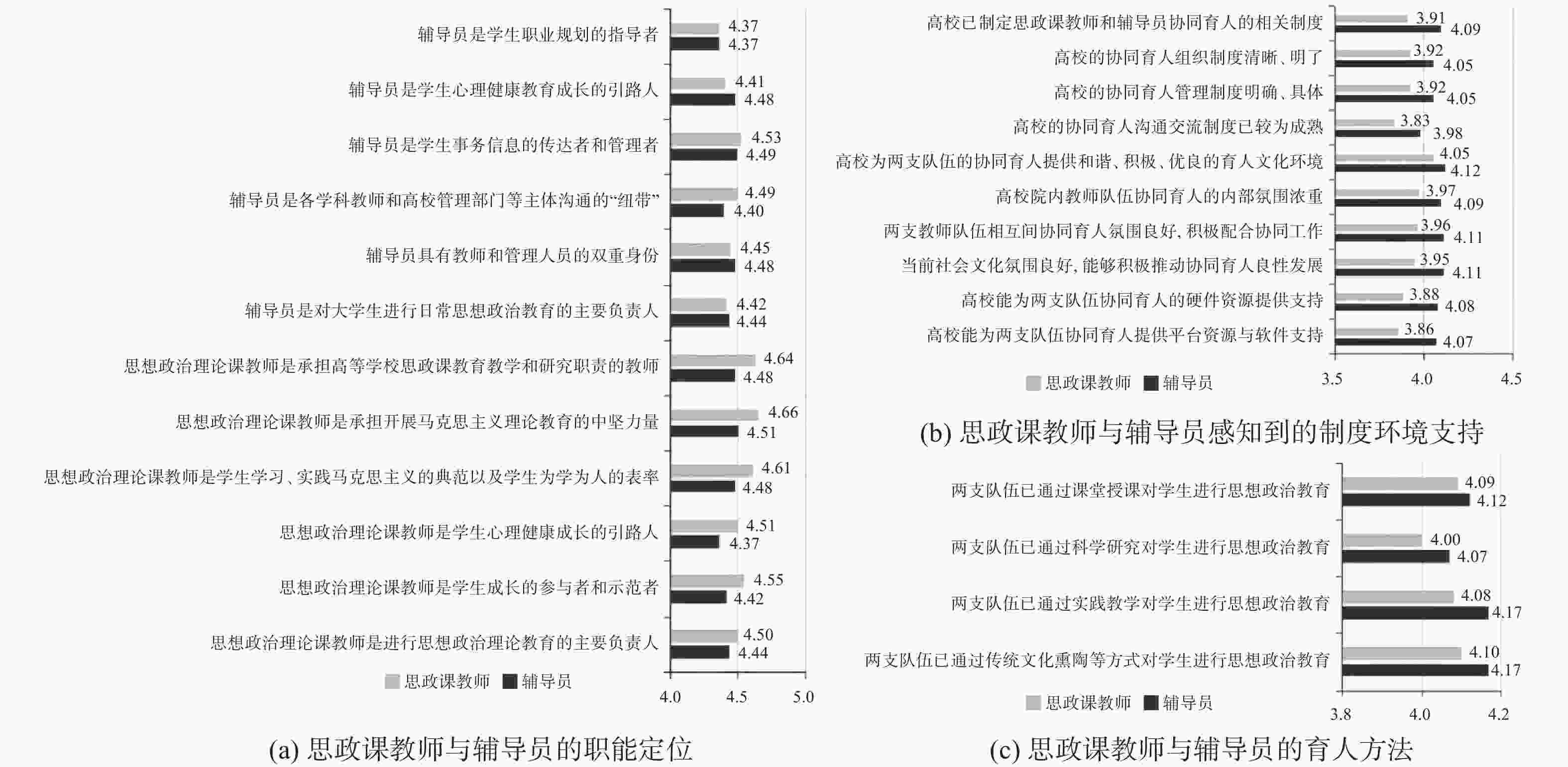
图 2 高校思政课教师队伍与辅导员队伍职能定位、育人方法、制度环境均值分布图. (a)思政课教师与辅导员的职能定位;(b)思政课教师与辅导员感知到的制度环境支持;(c)思政课教师与辅导员的育人方法
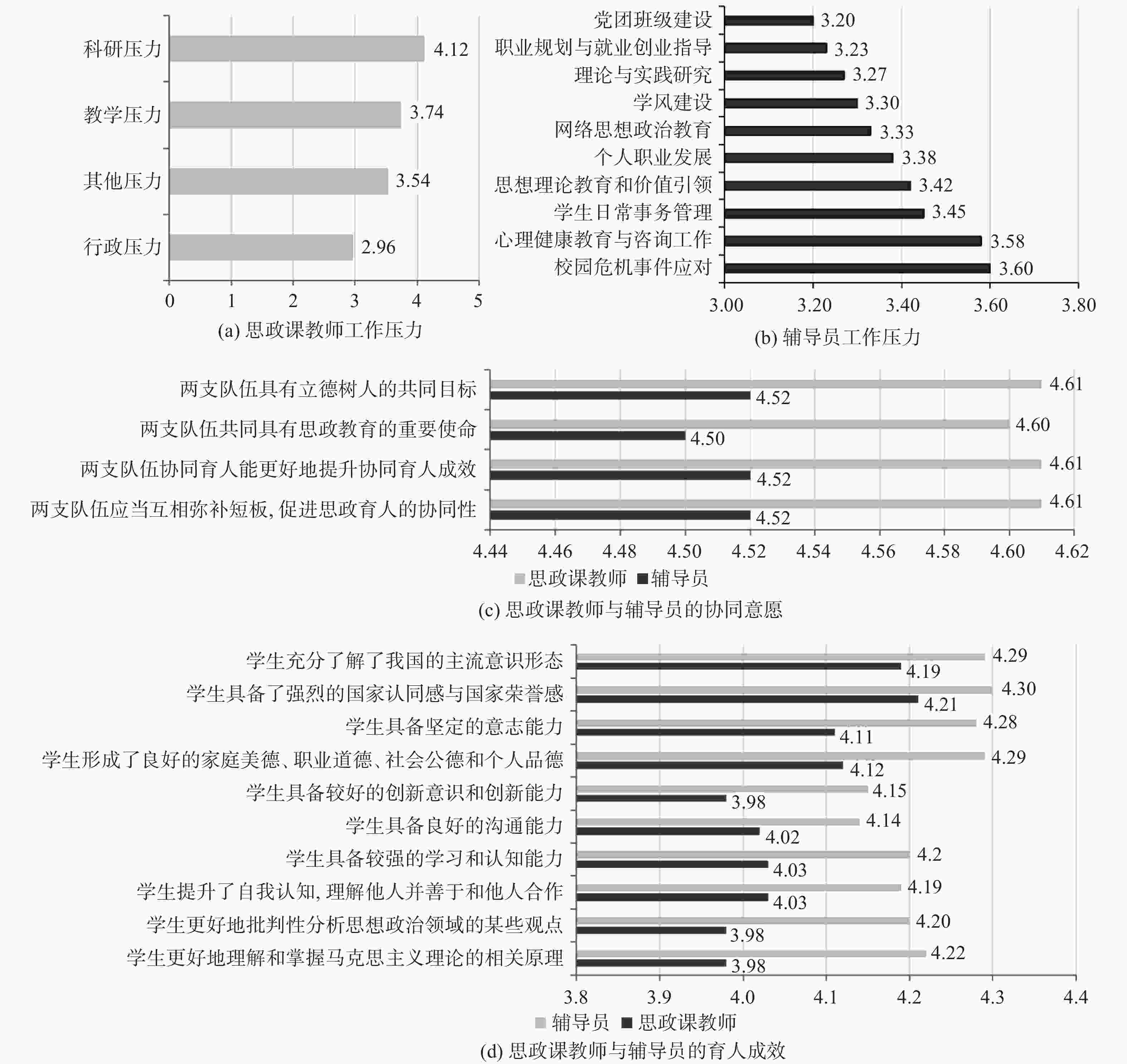
图 3 高校思政课教师队伍与辅导员队伍工作压力、协同意愿与育人成效均值分布图. (a)思政课教师工作压力;(b)辅导员工作压力;(c)思政课教师与辅导员的协同意愿;(d)思政课教师与辅导员的育人成效
表 1 样本统计的基本信息分布表
类别 属性 思政课教师样本 辅导员样本 频数 百分比/% 频数 百分比/% 性别 男 87 35.37 136 50.56 女 159 64.63 133 49.44 年龄 30岁及以下 10 4.06 145 53.90 31~40岁 83 33.74 99 36.80 41~50岁 98 39.84 23 8.55 51岁及以上 55 22.36 2 0.75 最高学历 本科 15 6.10 61 22.68 硕士 81 32.93 181 67.2 博士 150 60.97 27 10.03 职称 初级职称 16 6.50 152 56.51 中级职称 84 34.15 91 33.83 副高级职称 91 36.99 23 8.55 高级职称 55 22.36 3 1.11 现任职院校层次 “双一流”高校 83 33.74 126 46.84 非“双一流”高校 163 66.26 143 53.16  下载: 导出CSV
表 2 协同育人成效影响因素的分层回归分析表
变量 思政课教师 辅导员 模型1 模型2 模型3 模型4 模型1 模型2 模型3 模型4 育人能力 0.28*** 0.28*** 0.24*** 0.10** 0.10** 0.08* 职能定位 0.27*** 0.27*** 0.18** 0.28*** 0.28*** 0.13* 育人方法 0.20** 0.19** — 0.24*** 0.24*** 0.21*** 制度环境 0.23*** 0.23*** 0.23*** 0.38*** 0.38*** 0.36*** 工作压力 — — — — 协同意愿 0.19** 0.23*** 调整后的R2 0.29 0.77 0.77 0.78 0.05 0.79 0.79 0.80 R2 0.31 0.78 0.78 0.79 0.07 0.80 0.80 0.81 F值 21.03*** 93.88*** 84.35*** 80.05*** 4.04** 113.06*** 101.37*** 100.36*** 注:*表示p < 0.05,**表示p < 0.01,***表示p < 0.001;因变量为育人成效。
下载: 导出CSV
-
[1] 新华社. 习近平出席全国高校思想政治工作会议并发表重要讲话[EB/OL]. (2016-12-08) [2025-06-20]. https://www.xuexi.cn/746bd106b7d5dca0bc01f747f5bf37c0/e43e220633a65f9b6d8b53712cba9caa.html. [2] 中华人民共和国教育部. 新时代高等学校思想政治理论课教师队伍建设规定[EB/OL]. (2020-01-16)[2025-06-20]. http://www.moe.gov.cn/srcsite/A02/s5911/moe_621/202002/t20200207_418877.html. [3] 中华人民共和国教育部. 教育部等十部门关于印发《全面推进“大思政课”建设的工作方案》的通知[EB/OL]. (2022-08-10) [2025-06-20]. http://www.moe.gov.cn/srcsite/A13/moe_772/202208/t20220818_653672.html. [4] 胡绪明. 高校思政课教师与辅导员协同育人的功能定位及实施对策[J]. 学术论坛, 2018, 41(4): 174-180. [5] 王敏, 徐露璐. 大学生日常思想政治教育与思想政治理论课教学的协同性思考[J]. 大学教育, 2016(2): 56-58. [6] 王秀玉, 何正玲. 高校辅导员与思想政治理论课教师合力育人机制模式探讨[J]. 辽宁工业大学学报(社会科学版), 2018, 20(1): 98-100, 103. [7] 李丹. 学校导向的产学研协同育人影响因素及对策研究[J]. 黑龙江科学, 2019, 10(1): 36-37. [8] 钟贞山, 王磊. 高职产教融合协同育人共同体建设的影响因素分析: 基于扎根理论的研究[J]. 职教论坛, 2022, 38(4): 120-128. [9] 沈壮海, 王迎迎. 2016年度大学生思想政治教育状况调查分析: 基于全国35所高校的调查[J]. 中国高等教育, 2017(11): 45-50. [10] 司文超. 高校思想政治教育成效及其影响因素的调查分析[J]. 思想理论教育, 2022(1): 101-105. [11] 杨成兵, 秦宗槐, 陈晓燕. 新时代高校思政课教师与辅导员协同育人影响因素研究[J]. 就业与保障, 2022(3): 34-36. [12] 董凌莉. 理想信念教育视域下应用型高校实践育人探究[J]. 学校党建与思想教育, 2020(14): 68-70. doi: 10.19865/j.cnki.xxdj.2020.14.022 [13] Mêgnigbêto E. Modelling the triple helix of university-industry-government relationships with game theory: core, shapley value and nucleolus as indicators of synergy within an innovation system [J]. Journal of Informetrics, 2018, 12(4): 1118-1132. doi: 10.1016/j.joi.2018.09.005 [14] Bush A, Grotjohann N. Collaboration in teacher education: a cross-sectional study on future teachers’ attitudes towards collaboration, their intentions to collaborate and their performance of collaboration [J/OL]. Teaching and Teacher Education (2019-11-14) [2025-03-04]. https://www.sciencedirect.com/science/article/pii/S0742051X19302203. [15] Malin H. American identity development and citizenship education: a summary of perspectives and call for new research [J]. Applied Developmental Science, 2011, 15(2): 111-116. doi: 10.1080/10888691.2011.560817 [16] Hemmert M, Bstieler L, Okamuro H. Bridging the cultural divide: trust formation in university–industry research collaborations in the US, Japan, and South Korea [J]. Technovation, 2014, 34(10): 605-616. doi: 10.1016/j.technovation.2014.04.006 [17] Albet M S, Nasikhin N, Fihris F. Implementation and challenges of discipline character education [J]. Jurnal Pendidikan Karakter, 2024, 15(2): 120-124. doi: 10.21831/jpka.v15i2.77799 [18] 王思斌. 社会学教程: 第5版[M]. 北京: 北京大学出版社, 2021. [19] 赫尔曼·哈肯. 协同学: 大自然构成的奥秘[M]. 凌复华, 译. 上海: 上海译文出版社, 2005. [20] 客洪刚. 高校辅导员队伍与思政课教师队伍交流机制研究[J]. 教育科学, 2011, 27(6): 70-73. [21] 马聪, 刘娜. 精准思政视域下“四位一体”协同育人模式研究实践[J]. 北京科技大学学报(社会科学版), 2024, 40(4): 26-32. doi: 10.19979/j.cnki.issn10082689.2023110006 [22] 于杨, 王利锋, 金祥雷. 新时代大学教师转型发展: 挑战与对策[J]. 中国大学教学, 2021(6): 72-76. [23] 吴明隆. 问卷统计分析实务: SPSS操作与应用[M]. 重庆: 重庆大学出版社, 2010. [24] 张大均, 朱政光. 大学生心理素质的特点和影响因素: 基于对大学生线上调查数据的分析[J]. 教育研究, 2022, 43(7): 126-139. [25] 万美容, 曾兰. 90后女大学生心理特点的实证研究: 基于与男大学生的比较[J]. 中国青年研究, 2014(4): 67-72. doi: 10.3969/j.issn.1002-9931.2014.04.013 [26] 敖永春, 何祖娜. 大数据时代高校精准思政的价值意蕴、矛盾境遇与实施路径[J]. 北京科技大学学报(社会科学版), 2025, 41(2): 13-19. [27] 朱俊英, 王群. 加强高校辅导员自我认同的研究[J]. 思想理论教育, 2015(10): 108-111. [28] 李苏, 顾友仁. 数字技术赋能思政教育实效提升的三维理路[J]. 北京科技大学学报(社会科学版), 2026, 42(3): 53-59. doi: 10.19979/j.cnki.issn10082689.2024110002 -

 点击查看大图
图(3) / 表(2)
计量
- 文章访问数: 265
- HTML全文浏览量: 81
- PDF下载量: 18
- 被引次数: 0
