



AIGC Impact on and Reshaping of Expert AuthorityAnalysis Framework based on Authority Theory
-
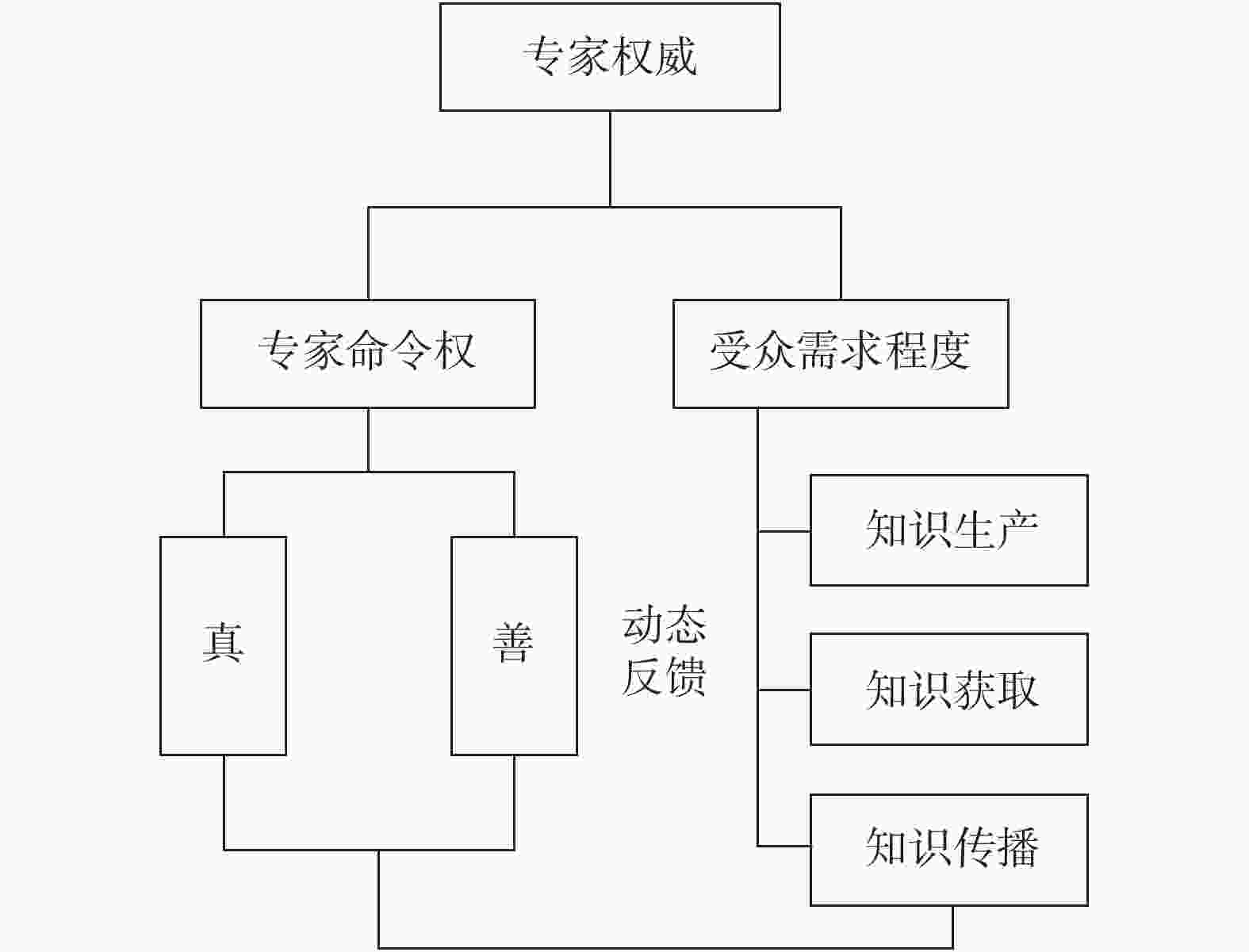
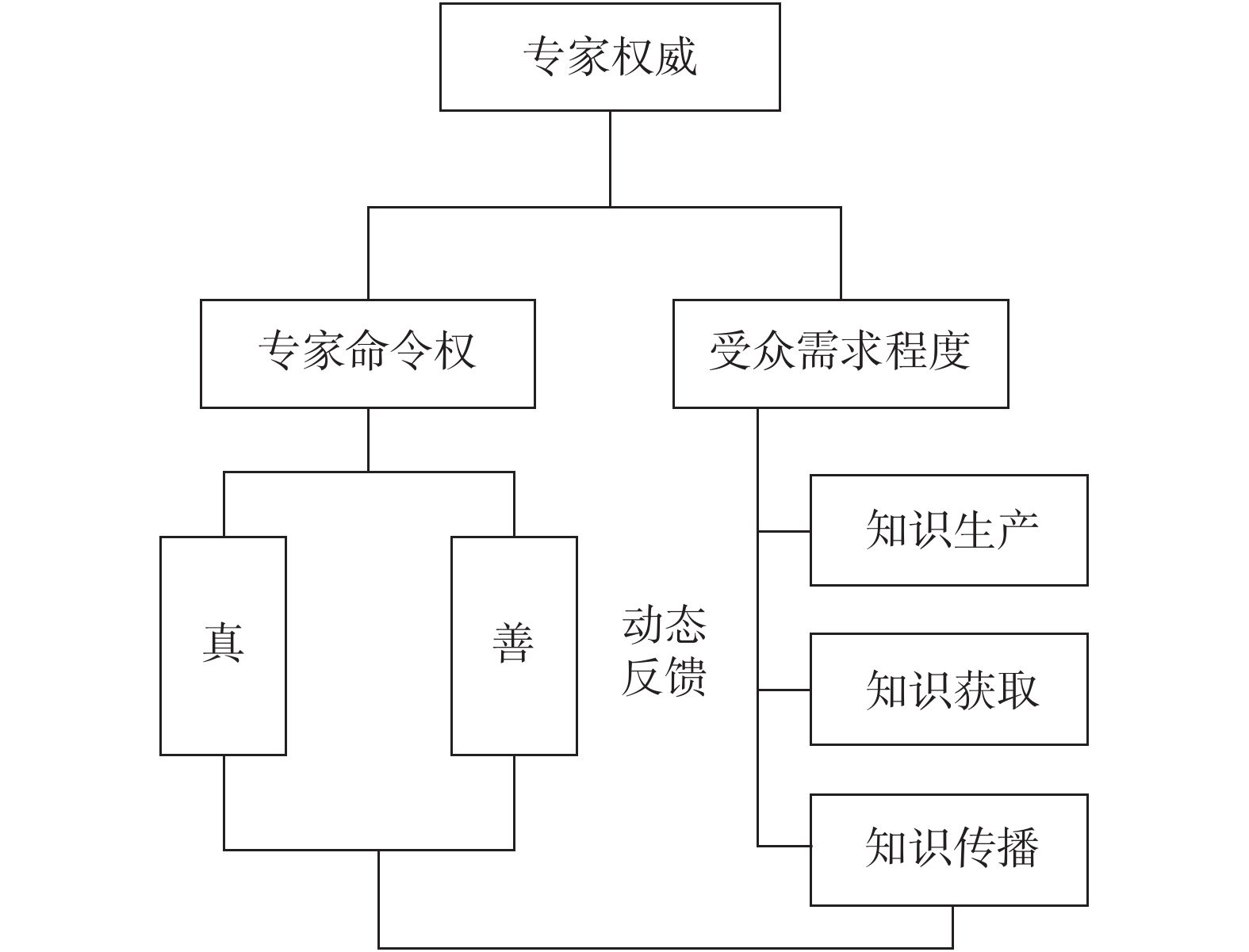
摘要: 人工智能技术的迭代升级和应用场景的多元化,对专家权威产生深刻影响,冲击与重塑了其核心机制。文章基于专家权威理论,构建起专业知识、评估方式、关联资源、价值规范、受众需求5个关键影响因素的整合型框架,归纳出人工智能技术重塑专家权威的过程与机理;并在此基础上,提出未来专家权威的实现形态和演进方向。文章发现,人工智能技术对专家权威的冲击体现在专家和社会受众两个层面。在专家层面,专家知识的“真”和专家行为的“善”均在不同程度上受到冲击;在社会受众层面,人工智能实现了知识赋权。针对人工智能技术内部的局限,专家共同体在知识生产和传播方面很大程度上进行了自我调整和完善,未来专家权威的实现形态和演进方向体现在专注向前探索、与社会深层沟通连接、对人工智能技术及数据修正、道德责任守护与知识创新引领等方面。Abstract: The iterative upgrading of artificial intelligence technology and the diversification of application scenarios have profoundly impacted on expert authority. The core mechanism of AIGC impacting and reshaping expert authority needs to be explored. Based on the theory of expert authority, this study constructs an integrated framework of five key influencing factors, including professional knowledge, evaluation methods, related resources, value norms, and audience needs. It summarizes the process and mechanism of AIGC reshaping expert authority. On this basis, the realization form and evolution direction of future expert authority are proposed. The research results show that: (1) The impact of AIGC on expert authority is reflected at two levels: experts and social audience. At the expert level, both the “truth” of expert knowledge and the “goodness” of expert behavior are impacted by AIGC to varying degrees; at the social audience level, AIGC has achieved knowledge empowerment and promoted the process of knowledge democratization. (2) In response to the limitations of AIGC, the expert community has made self-adjustments and improvements in knowledge production and dissemination to a large extent. The irreplaceable superiority of experts lies in creativity, emotion, morality, and humanistic care, which constitute the core values of experts. (3) On this basis, the realization form and evolution direction of expert authority in the future will be reflected in focusing on forward exploration, deep communication and connection with society, correction of AI technology and data, adherence to moral responsibility, and leading the direction of knowledge creation.
-
Key words:
- AIGC /
- expert authority /
- knowledge production /
- knowledge empowerment /
- reshaping mechanism
-
[1] 安东尼·吉登斯, 乌尔里希·贝克, 斯科特·拉什. 自反性现代化: 现代社会秩序中的政治、传统与美学[M]. 赵文书, 译. 北京: 商务印书馆, 2001. [2] GOODWIN J. Forms of authority and the real ad verecundiam [J]. Argumentation, 1998, 12(2): 267-280. doi: 10.1023/A:1007756117287 [3] 沈湘平. 现代性视野中的专家系统[J]. 学习与探索, 2007(2): 43-47, 237. doi: 10.3969/j.issn.1002-462X.2007.02.008 [4] ABBOTT A. The System of Professions: An Essay on the Division of Expert Labor [M]. Chicago: University of Chicago press, 2014. [5] 冯戎, 吴学琴. 数字资本的“智能”统御与主体复归——基于芬伯格“技术民主”理路的审思[J]. 北京科技大学学报(社会科学版), 2024, 40(2): 24-32. [6] 张夏恒, 马妍. 生成式人工智能技术赋能新质生产力涌现: 价值意蕴、运行机理与实践路径[J]. 电子政务, 2024(4): 17-25. [7] 汉娜·阿伦特. 过去与未来之间[M]. 王寅丽, 张立立, 泽. 南京: 译林出版社, 2011. [8] 彼得·布劳. 社会生活中的交换与权力[M]. 李国武, 译. 北京: 商务印书馆, 2012. [9] 罗伯特·达尔, 布鲁斯·斯泰恩布里克纳. 现代政治分析[M]. 吴勇, 译. 北京: 中国人民大学出版社, 2012. [10] 乔万尼·萨托利. 民主新论[M]. 冯克利, 阎克文, 译. 上海: 上海人民出版社, 2009. [11] ERIKSON E & PARENT J M. Central authority and order [J]. Sociological Theory, 2007, 25(3): 245-267. doi: 10.1111/j.1467-9558.2007.00307.x [12] BOURDIEU P. The specificity of the scientific field and the social conditions of the progress of reason [J]. Social Science Information, 1975, 14(6): 31-50. [13] LARSON M S. The Rise of Professionalism: A Sociological Analysis [M]. London and New York: Routledge, 2017. [14] EYAL G & MEDVETZ T. The Oxford Handbook of Expertise and Democratic Politics [M]. Oxford: Oxford University Press, 2023. [15] NOY S & ZHANG W. Experimental evidence on the productivity effects of generative artificial intelligence [J]. Science, 2023, 381(6654): 187-192. doi: 10.1126/science.adh2586 [16] AGRAWAL A, GANS J S & GOLDFARB A. Exploring the impact of artificial intelligence: Prediction versus judgment [J]. Information Economics and Policy, 2019, 47(3): 1-6. [17] DILSIZIAN S E & SIEGEL E L. Artificial intelligence in medicine and cardiac imaging: Harnessing big data and advanced computing to provide personalized medical diagnosis and treatment [J]. Current Cardiology Reports, 2014, 16(1): 1-8. [18] LEBOVITZ S, LEVINA N & LIFSHITZ-ASSAF H. Is AI ground truth really true? The dangers of training and evaluating AI tools based on experts’ know-what [J]. MIS Quarterly, 2021, 45(3): 1501-1525. doi: 10.25300/MISQ/2021/16564 [19] ELMIRA V D B, SERGEEVA A & HUYSMAN M. When the machine meets the expert: An ethnography of developing AI for hiring [J]. MIS Quarterly, 2021, 45(3): 1557-1580. doi: 10.25300/MISQ/2021/16559 [20] 阮凯. 人工智能知识生产的核心争议与深层局限的哲学反思[J]. 自然辩证法研究, 2024, 40(3): 66-73. doi: 10.19484/j.cnki.1000-8934.2024.03.003 [21] GIRTON M R, GREENE D N, MESSERLIAN G, et al. ChatGPT vs medical professional: Analyzing responses to laboratory medicine questions on social media [J]. Clinical Chemistry, 2024, 70(9): 1122-1139. doi: 10.1093/clinchem/hvae093 [22] 刘霞. 他们用AI破译蛋白质结构“密码”[N]. 科技日报, 2024-10-10(02). [23] 丹尼尔·科伊尔. 一万小时天才理论[M]. 张科丽, 译. 北京: 中国人民大学出版社, 2010. [24] 李艳红. 专业何以正当化: 再论新闻权威概念[J]. 社会科学文摘, 2024(9): 64-66. [25] BRYNJOLFSSON E & MCAFEE A. The Second Machine Age: Work, Progress, and Prosperity in a Time of Brilliant Technologies [M]. New York: W. W Norton & company, 2014. [26] 李大强, 许双. ChatGPT会说话吗? ——AI、心灵与语言[J]. 社会科学战线, 2023(5): 48-56. [27] TSOUKAS H. The firm as a distributed knowledge system: A constructionist approach [J]. Strategic Management Journal, 1996, 17(S2): 11-25. [28] GITELMAN L. Raw Data Is an Oxymoron [M]. Cambridge: MIT Press, 2013. [29] 胡正荣, 闫佳琦. 生成式人工智能的价值对齐比较研究——基于2012—2023年十大国际新闻生成评论的实验[J]. 新闻大学, 2024(3): 1-17, 117. doi: 10.20050/j.cnki.xwdx.2024.03.007 [30] JONAS H. Technology and responsibility: Reflections on the new tasks of ethics [J]. Social Research, 1973, 40(1): 31-54. [31] 陈艺心. GAI时代研究生培养面临的机遇挑战及应对[J]. 北京科技大学学报(社会科学版), 2025, 41(6): 69-74. [32] LARSON M S. Professionalism: The third logic [J]. Perspectives in Biology and Medicine, 2003, 46(3): 458-462. doi: 10.1353/pbm.2003.0037 [33] GIERYN T F. Cultural Boundaries of Science: Credibility on the Line [M]. Chicago: University of Chicago Press, 1999. [34] SCHULTZE U & LEIDNER D E. Studying knowledge management in information systems research: Discourses and theoretical assumptions [J]. MIS Quarterly, 2002, 26(3): 213-242. doi: 10.2307/4132331 [35] LAW A & SPINARDI G. Performing expertise in building regulation: ‘Codespeak’and fire safety experts [J]. Minerva, 2021, 59(4): 515-538. doi: 10.1007/s11024-021-09446-5 [36] LATOUR B. Love your monsters [J]. Breakthrough Journal, 2011(2): 21-28. [37] COLLINS H M & EVANS R. The third wave of science studies: Studies of expertise and experience [J]. Social studies of science, 2002, 32(2): 235-296. doi: 10.1177/0306312702032002003 [38] NELSEN B J & BARLEY S R. For love or money? Commodification and the construction of an occupational mandate [J]. Administrative Science Quarterly, 1997, 42(4): 619-653. doi: 10.2307/2393652 [39] MOON K. Homogenizing Effect of Large Language Model on Creativity: An Empirical Comparison of Human and ChatGPT Writing [D]. Washington: Georgetown University, the Graduate School of Arts and Sciences, 2024. -

 下载:
下载:
 点击查看大图
图(1)
计量
- 文章访问数: 1035
- HTML全文浏览量: 179
- PDF下载量: 26
- 被引次数: 0
