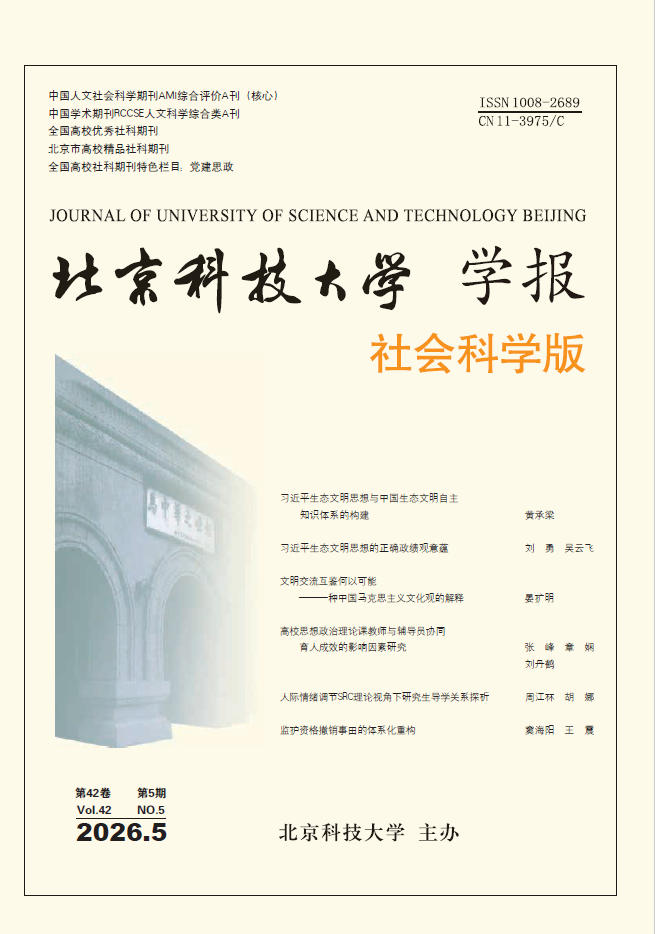
Volume 43 Issue 5
Oct.  2026
Turn off MathJax
Article Contents
Yan Kuoming. How Are Exchanges and Mutual Learning Between Civilizations Possible?[J]. Journal of University of Science and Technology Beijing ( Social Sciences Edition), 2026, 42(5): 24-32. doi: 10.19979/j.cnki.issn10082689.2026040031
Citation: Yan Kuoming. How Are Exchanges and Mutual Learning Between Civilizations Possible?[J]. Journal of University of Science and Technology Beijing ( Social Sciences Edition), 2026, 42(5): 24-32. doi: 10.19979/j.cnki.issn10082689.2026040031

How Are Exchanges and Mutual Learning Between Civilizations Possible?-An Interpretation from the Perspective of Chinese Marxist Cultural View

doi: 10.19979/j.cnki.issn10082689.2026040031
  • Received Date: 2026-04-07
    Available Online: 2026-06-29
  • Publish Date: 2026-10-01
  • Under the historical conditions of in-depth advancement of global modernization and continuous formation of a shared world, exchanges and mutual learning between civilizations have increasingly become important theoretical and practical issues that must be addressed in the 21st century. The crux of the issue lies not in eliminating civilizational differences, but in how to construct a realistic and feasible common foundation for the coexistence of diverse civilizations on the premise of acknowledging and preserving differences. Since the New Era, the contemporary Chinese Marxist cultural outlook, based on the “Two Integrations” and represented by Xi Jinping Thought on Culture, has further deepened the understanding of the laws of cultural construction, the development of socialist culture, and the evolution of human civilization. It adheres to understanding cultural and civilizational issues from the perspective of history, practice and global connections, opposes the dissolution of civilizational differences through abstract universality, and opposes the absolutization of civilizational differences as closed boundaries, thereby providing a systematic theoretical perspective for explaining the possibility of exchanges and mutual learning between civilizations. Specifically, cultural subjectivity constitutes the premise of civilizational dialogue, enabling different civilizations to engage in equal exchanges based on their own historical experiences and value structures; openness and inclusiveness constitute the basic stance of mutual learning between civilizations, preventing civilizational relations from sliding into homogenization and conflict; the common values of all mankind provide a normative medium for different civilizations to conduct value communication and reach practical consensus on common issues; building a community with a shared future for mankind further advances this value consensus into a practical form of real-world cooperation, shared destinies and order reshaping. This theoretical approach not only reveals the internal logic that makes exchanges and mutual learning between civilizations possible, but also offers a Chinese perspective for diverse civilizations in the contemporary world to achieve mutual understanding, mutual recognition and common development.


  • loading
  • [1]
    塞缪尔·亨廷顿. 文明的冲突与世界秩序的重建[M]. 周琪, 刘绯, 张立平, 等, 译. 北京: 新华出版社, 2010.
    [2]
    习近平. 论坚持推动构建人类命运共同体[M]. 北京: 中央文献出版社, 2018.
    [3]
    马克思, 恩格斯. 马克思恩格斯文集: 第9卷[M]. 中共中央马克思恩格斯列宁斯大林著作编译局, 编, 译. 北京: 人民出版社, 2009.
    [4]
    李俊文. 中国马克思主义文化观的演进历程探析[J]. 山东社会科学, 2025(12): 5-12.
    [5]
    习近平. 习近平谈治国理政: 第5卷[M]. 北京: 外文出版社, 2025.
    [6]
    韩蒙. 作为生命体的中国: 马克思主义文化理论的方法论自觉[J]. 当代中国马克思主义研究, 2025(1): 60-65.
    [7]
    习近平. 习近平文化思想学习纲要[M]. 北京: 学习出版社, 2024.
    [8]
    习近平. 高举中国特色社会主义伟大旗帜 为全面建设社会主义现代化国家而团结奋斗: 在中国共产党第二十次全国代表大会上的报告[M]. 北京: 人民出版社, 2022.
    [9]
    晏扩明, 林欣玮. 从“全球文明倡议”中读懂构建人类命运共同体的世界意义[J]. 福建技术师范学院学报, 2023, 41(4): 405-410, 417.
    [10]
    庞敏. 论人类文明新形态的社会主义性质及其文化底蕴[J]. 济南大学学报(社会科学版), 2025, 35(6): 66-73.
    [11]
    胡晶晶. 从普遍性到特殊性: 文化主体性的认知重构与演化[J]. 江淮论坛, 2025(2): 12-18.
    [12]
    韩升, 段昀辉. 世界文明交流互鉴的文化主体间性证成[J]. 新疆社会科学, 2025(6): 117-125, 173. doi: 10.20003/j.cnki.xjshkx.2025.06.010
    [13]
    邹广文, 韩丹阳. 论文化多样性与全人类共同价值的辩证统一[J]. 世界社会主义研究, 2026, 11(2): 25-38, 133-134.
    [14]
    陈飞. 文化主体性: 基于社会理性的哲学探讨[J]. 南京社会科学, 2026(1): 20-29.
    [15]
    布鲁斯·马兹利什. 文明及其内涵[M]. 汪辉, 译. 刘文明, 校. 北京: 商务印书馆, 2017.
    [16]
    习近平. 习近平重要讲话单行本(2023年合订本)[M]. 北京: 人民出版社, 2024.
    [17]
    刘同舫. 构建人类命运共同体对历史唯物主义的原创性贡献[J]. 中国社会科学, 2018(7): 4-21, 204.
    [18]
    习近平. 习近平谈治国理政: 第4卷[M]. 北京: 外文出版社, 2022.
    [19]
    陈曙光. “世界之问”与中国方案[M]. 北京: 人民出版社, 2022.
    [20]
    王大千. “一带一路”倡议对外话语传播体系的进展、挑战及对策[J]. 北京科技大学学报(社会科学版), 2025, 41(1): 16-23. doi: 10.19979/j.cnki.issn10082689.2024050139
  • 加载中

Catalog

    通讯作者: 陈斌, bchen63@163.com
    • 1. 

      沈阳化工大学材料科学与工程学院 沈阳 110142

    1. 本站搜索
    2. 百度学术搜索
    3. 万方数据库搜索
    4. CNKI搜索

    Article Metrics

    Article views (45) PDF downloads(32) Cited by()
    Proportional views
    Related

    /

    DownLoad:  Full-Size Img  PowerPoint
    Return
    Return