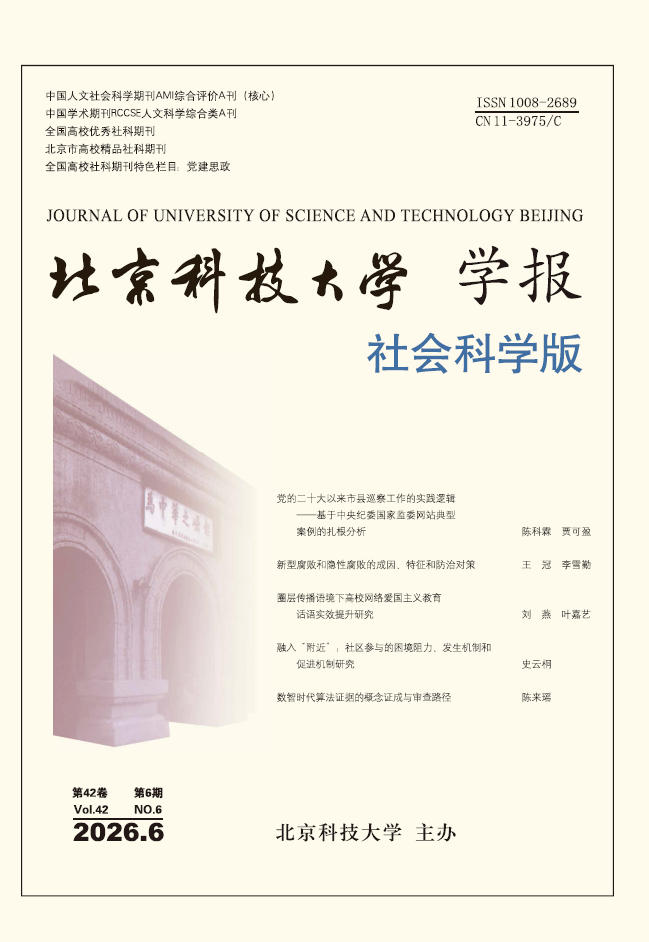
Volume 43 Issue 6
Dec.  2026
Turn off MathJax
Article Contents
Shi Qu. A Multi-dimensional Analysis of Classical Chinese Culture as the Finest Form of Aesthetic Expression Among Youth[J]. Journal of University of Science and Technology Beijing ( Social Sciences Edition), 2026, 42(6): 39-45. doi: 10.19979/j.cnki.issn10082689.2026010036
Citation: Shi Qu. A Multi-dimensional Analysis of Classical Chinese Culture as the Finest Form of Aesthetic Expression Among Youth[J]. Journal of University of Science and Technology Beijing ( Social Sciences Edition), 2026, 42(6): 39-45. doi: 10.19979/j.cnki.issn10082689.2026010036

A Multi-dimensional Analysis of Classical Chinese Culture as the Finest Form of Aesthetic Expression Among Youth

doi: 10.19979/j.cnki.issn10082689.2026010036
  • Received Date: 2025-11-09
  • Publish Date: 2026-12-01
  • In recent years, classic Chinese culture has become the finest form of aesthetic expression among youth, one of the mainstream aesthetic forms featuring wide circulation, high recognition and strong guiding influence within youth groups. This cultural phenomenon has taken shape in the contemporary context where the “Two Combinations” provide theoretical guidance, cultural confidence offers solid support, and the building of a culturally strong nation provides strategic backing. It is also driven by internal motivations: the recognition of cultural values awakens young people’s aesthetic awareness of Chinese classical style, the spirit of traditional culture consoles young people and relieves their psychological anxiety, and symbols of social circles help them construct their identity. Based on relevant research on youth aesthetics, this paper puts forward practical implications including actively promoting the protection and inheritance of cultural heritage, continuously strengthening the building of international communication capacity, and further deepening exchanges and mutual learning among world civilizations. It aims to guide young people to safeguard the root and soul of the Chinese nation, cultivate them to become a new force for mainstream aesthetics, and join hands with them to build a garden where all beauties thrive together. In this way, tradition and modernity are integrated, and Chinese culture shines more brilliantly.


  • loading
  • [1]
    国家主席习近平发表二〇二六年新年贺词[N]. 人民日报, 2026-01-01(1).
    [2]
    习近平. 在文化传承发展座谈会上的讲话[J]. 求是, 2023(17): 4-11.
    [3]
    中共中央宣传部. 习近平文化思想学习纲要[M]. 北京: 学习出版社. 2024.
    [4]
    马克思. 《政治经济学批判》序言、导言[M]. 北京: 人民出版社, 1971.
    [5]
    贺新元, 刘弘雨. 中国共产党文化领导权建设的历史演进、内在理路与当代启示: 基于对待传统文化的视角[J]. 北京科技大学学报(社会科学版), 2025, 41(5): 11-22.
    [6]
    施郑理. 党领导文化主体性建构的三个重要维度[J]. 思想政治工作研究, 2024(5): 6-9.
    [7]
    习近平文化思想研究中心秘书处. 习近平文化思想实践案例选编[M]. 北京: 学习出版社, 2024.
    [8]
    习近平. 加快建设文化强国[EB/OL]. (2025-04-15) [2026-03-31]. https://www.qstheory.cn/20250415/0bc2022e17ea489db4445494b72959af/c.html.
    [9]
    中华人民共和国国务院. 中华人民共和国国民经济和社会发展第十五个五年规划纲要[EB/OL]. (2026-03-13) [2026-03-31]. https://www.gov.cn/yaowen/liebiao/202603/content_7062633.htm.
    [10]
    冯刚, 鲁力. 习近平关于中华优秀传统文化重要论述的理论蕴涵[J]. 湖南大学学报(社会科学版), 2022, 36(1): 1-10. doi: 10.16339/j.cnki.hdxbskb.2022.01.001
    [11]
    中共中央办公厅 国务院办公厅印发《关于实施中华优秀传统文化传承发展工程的意见》[EB/OL]. (2017-01-25) [2026-03-31]. https://www.gov.cn/zhengce/2017-01/25/content_5163472.htm.
    [12]
    新华社. 习近平在河南考察时强调 坚定信心推动高质量发展高效能治理 奋力谱写中原大地推进中国式现代化新篇章[EB/OL]. (2025-05-20) [2026-03-31]. https://www.xinhuanet.com/politics/20250520/022a05a77f524a5f8f8c58a20720dc61/c.html.
  • 加载中

Catalog

    通讯作者: 陈斌, bchen63@163.com
    • 1. 

      沈阳化工大学材料科学与工程学院 沈阳 110142

    1. 本站搜索
    2. 百度学术搜索
    3. 万方数据库搜索
    4. CNKI搜索

    Article Metrics

    Article views (7) PDF downloads(0) Cited by()
    Proportional views
    Related

    /

    DownLoad:  Full-Size Img  PowerPoint
    Return
    Return