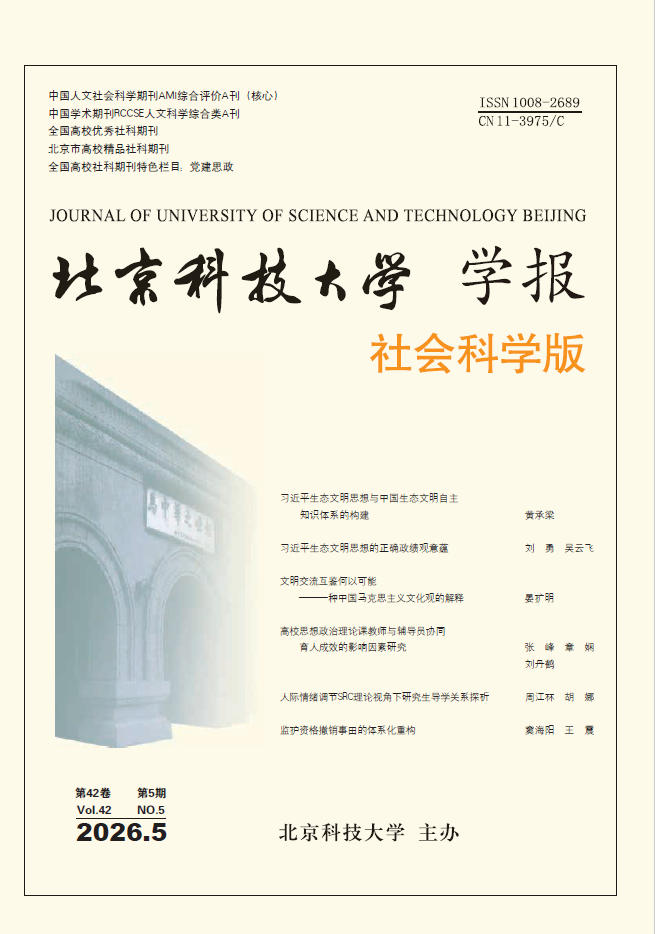
Volume 43 Issue 5
Oct.  2026
Turn off MathJax
Article Contents
Yang Zhida. Research on the “Slow Employment” Phenomenon among Students in Science and Engineering Universities from the Perspective of New Engineering[J]. Journal of University of Science and Technology Beijing ( Social Sciences Edition), 2026, 42(5): 92-98. doi: 10.19979/j.cnki.issn10082689.2026030083
Citation: Yang Zhida. Research on the “Slow Employment” Phenomenon among Students in Science and Engineering Universities from the Perspective of New Engineering[J]. Journal of University of Science and Technology Beijing ( Social Sciences Edition), 2026, 42(5): 92-98. doi: 10.19979/j.cnki.issn10082689.2026030083

Research on the “Slow Employment” Phenomenon among Students in Science and Engineering Universities from the Perspective of New Engineering

doi: 10.19979/j.cnki.issn10082689.2026030083
  • Received Date: 2026-01-08
    Available Online: 2026-06-29
  • Publish Date: 2026-10-25
  • From the perspective of the new engineering, “slow employment” has become a noteworthy new phenomenon among students in science and engineering universities. Based on human capital and social support theories, this study establishes a four-dimensional analysis framework covering “individual-school-family-society”. With reference to questionnaire survey data, it systematically analyzes the behavioral characteristics, influencing factors, and governance pathways of “slow employment” among students in science and engineering universities. The research finds that affected by the misalignment between educational supply and industrial demand, differentiated family support conditions, and macro-level institutional environment adjustments, students’ choices for “slow employment” are primarily driven by rational planning for their long-term personal development. Given that the phenomenon of “slow employment” results from combined multiple driving factors, this study proposes systematic governance pathway recommendations from four dimensions: empowering individuals, innovating cultivation approaches, fostering consensus, and optimizing the ecosystem, aiming to provide valid references for high-quality cultivation of new engineering talents and improvement of employment guidance services.


  • loading
  • [1]
    陈伟, 易芬云, 吴世勇. 新工科人才培养的目标逻辑和过程逻辑[J]. 高教探索, 2020(10): 42-48.
    [2]
    别敦荣. 从教育强国建设看普及化高等教育发展[J]. 中部高教研究, 2025, 1(1): 19-23.
    [3]
    孙长林. 基于企业需求的大学生就业能力培养路径探析[J]. 北京科技大学学报(社会科学版), 2026, 42(2): 42-50. doi: 10.19979/j.cnki.issn10082689.2025100044
    [4]
    黄少成, 唐雨晴. 高校“慢就业”群体画像、成因及对策[J]. 思想理论教育, 2024(9): 107-111. doi: 10.16075/j.cnki.cn31-1220/g4.2024.09.009
    [5]
    周文杰, 何子杰. 高校毕业生“慢就业”现象的辩证审思与动因探析[J]. 时代青年, 2025(30): 123-125.
    [6]
    李实, 张钰丹. 人力资本理论与教育收益率研究[J]. 北京大学教育评论, 2020, 18(1): 59-79, 189-190.
    [7]
    冯喜良, 苏建宁, 邱玥. 就业能力对高校毕业生慢就业选择的影响[J]. 人口与经济, 2024(5): 78-91.
    [8]
    李宁. 高校毕业生“慢就业”的缘由与对策[J]. 人民论坛, 2019(14): 116-117. doi: 10.3969/j.issn.1004-3381.2019.14.048
    [9]
    Coleman J S. Social capital in the creation of human capital [J]. American Journal of Sociology, 1988, 94(S1): S95-S120. doi: 10.1093/oso/9780195159509.003.0007
    [10]
    姜波, 周一航, 周浪. 高校毕业生“慢就业”问题再审视: 基于时间社会学的考察[J]. 中国青年研究, 2025(4): 34-42. doi: 10.19633/j.cnki.11-2579/d.2025.0033
  • 加载中

Catalog

    通讯作者: 陈斌, bchen63@163.com
    • 1. 

      沈阳化工大学材料科学与工程学院 沈阳 110142

    1. 本站搜索
    2. 百度学术搜索
    3. 万方数据库搜索
    4. CNKI搜索

    Tables(1)

    Article Metrics

    Article views (35) PDF downloads(8) Cited by()
    Proportional views
    Related

    /

    DownLoad:  Full-Size Img  PowerPoint
    Return
    Return