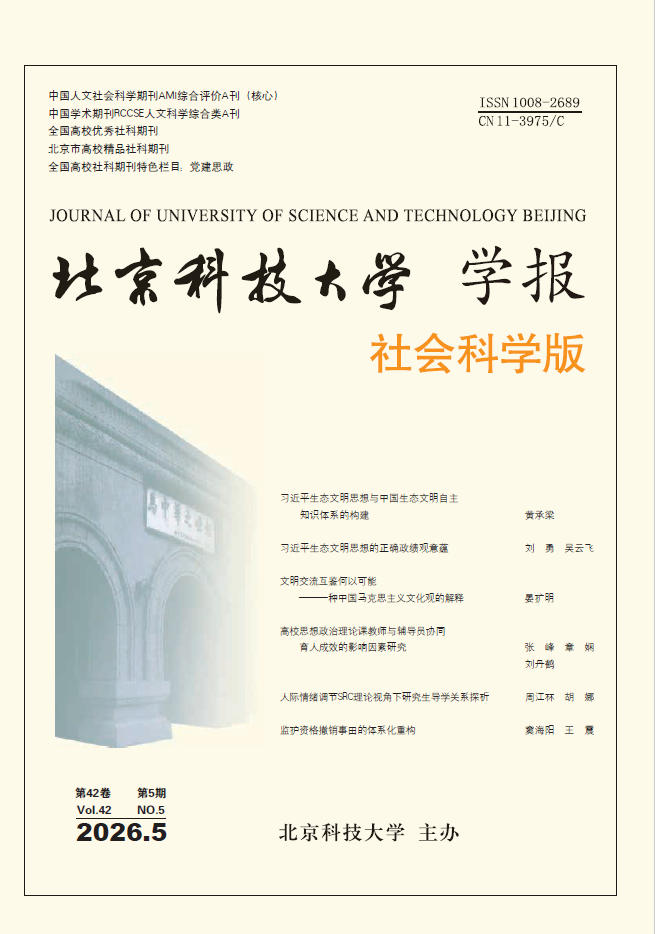
Volume 43 Issue 5
Oct.  2026
Turn off MathJax
Article Contents
Yan Xiaohui, Chen Siyi, Chen Xinying. The Connotation, Logic, and Pathways of Artificial Intelligence Empowering the Construction of Student Party Branches from the Perspective of Digital Governance[J]. Journal of University of Science and Technology Beijing ( Social Sciences Edition), 2026, 42(5): 64-70. doi: 10.19979/j.cnki.issn10082689.2026020007
Citation: Yan Xiaohui, Chen Siyi, Chen Xinying. The Connotation, Logic, and Pathways of Artificial Intelligence Empowering the Construction of Student Party Branches from the Perspective of Digital Governance[J]. Journal of University of Science and Technology Beijing ( Social Sciences Edition), 2026, 42(5): 64-70. doi: 10.19979/j.cnki.issn10082689.2026020007

The Connotation, Logic, and Pathways of Artificial Intelligence Empowering the Construction of Student Party Branches from the Perspective of Digital Governance

doi: 10.19979/j.cnki.issn10082689.2026020007
  • Received Date: 2025-12-04
    Available Online: 2026-06-29
  • Publish Date: 2026-10-25
  • In the context of the deep integration of the digital governance wave and educational digitalization strategies, artificial intelligence (AI) presents a historic opportunity for the paradigm shift in the construction of university student Party branches. Grounded in digital governance theory, this paper systematically explores the connotation evolution, logical mechanisms, and practical pathways of AI-empowered construction of university student Party branches. This study believes that empowering the construction of university student Party branches with artificial intelligence, in essence, is to use AI methods to address the issue of how student Party branches can achieve a governance transformation from standardized management to precise education under conditions of high member turnover and active thinking among young Party members; AI empowerment is mainly reflected in the evolution of connotations in three dimensions: organization, function, and system; its internal logic lies in the deepening of concepts driven by educational goals, the optimization of mechanisms driven by information needs, and the upgrading of paradigms driven by quality objectives. On this basis, this study constructs a closed-loop practical pathway characterized by precise evaluation to guide direction, data fusion to consolidate the foundation, institutional norms to ensure operation, and a human-centered orientation to realize value, thereby providing theoretical reference and practical guidance for improving the quality of Party construction among university students in the new era.


  • loading
  • [1]
    汪芯瑜, 刘素贞. 数智技术赋能高校党建: 场景与路径[J]. 党政论坛, 2025(1): 16-18.
    [2]
    米华全, 刘昱伶. 数字党建的概念廓清、态势特征与发展路向[J]. 思想理论教育, 2023(9): 78-83.
    [3]
    王家斌. 数字技术赋能基层党建的路径思考[J]. 理论视野, 2025(2): 89-95. doi: 10.19632/j.cnki.11-3953/a.2025.02.013
    [4]
    周建华. 数字技术赋能高校党建工作质量提升的路径探析[J]. 理论视野, 2024(8): 72-77.
    [5]
    于茜. 数字技术赋能高校党建的表现、风险与路径[J]. 学校党建与思想教育, 2025(3): 47-50.
    [6]
    敖永春, 何祖娜. 大数据时代高校精准思政的价值意蕴、矛盾境遇与实施路径[J]. 北京科技大学学报(社会科学版), 2025, 41(2): 13-19. doi: 10.19979/j.cnki.issn10082689.2024030012
    [7]
    新华社. 中共中央、国务院印发《关于新时代加强和改进思想政治工作的意见》[EB/OL]. (2021-07-12) [2026-01-06]. http://www.moe.gov.cn/jyb_xwfb/s6052/moe_838/202107/t20210713_544151.html.
    [8]
    国务院. 国务院关于深入实施“人工智能+”行动的意见[EB/OL]. (2025-08-26) [2026-01-06]. https://www.gov.cn/zhengce/content/202508/content_7037861.htm.
    [9]
    新华社. 中共中央关于制定国民经济和社会发展第十五个五年规划的建议[EB/OL]. (2025-10-28) [2026-01-06]. https://www.gov.cn/zhengce/202510/content_7046050.htm.
    [10]
    王刚, 宋锴业. 治理理论的本质及其实现逻辑[J]. 求实, 2017(3): 50-65.
    [11]
    郁建兴, 刘大志. 治理理论的现代性与后现代性[J]. 浙江大学学报(人文社会科学版), 2003(2): 6-14. doi: 10.3785/j.issn.1008-942X.2003.02.001
    [12]
    韩兆柱, 马文娟. 数字治理理论研究综述[J]. 甘肃行政学院学报, 2016(1): 23-35.
    [13]
    陈艺心. GAI时代研究生培养面临的机遇挑战及应对[J]. 北京科技大学学报(社会科学版), 2025, 41(6): 69-74. doi: 10.19979/j.cnki.issn10082689.2025050045
    [14]
    赵智兴, 段鑫星. 人工智能视域下的大学内部治理: 逻辑、困境与路径[J]. 西南民族大学学报(人文社科版), 2020, 41(10): 218-224.
    [15]
    颜隆忠, 李黄骏. 数字党建: 数字化时代党建工作新方式[J]. 福建师范大学学报(哲学社会科学版), 2023(6): 11-17. doi: 10.12046/j.issn.1000-5285.2023.06.002
    [16]
    黄泺, 陈玉书. 新时代高校“智慧党建”系统实践创新研究[J]. 学校党建与思想教育, 2020(18): 41-42, 45.
    [17]
    武晶晶. 数字技术赋能高校智慧党建工作体系建设[J]. 中国高等教育, 2023(12): 46-49.
    [18]
    米华全. 人工智能嵌入党内治理风险: 生成机理、形态表征与应对策略[J]. 理论月刊, 2022(4): 30-39.
  • 加载中

Catalog

    通讯作者: 陈斌, bchen63@163.com
    • 1. 

      沈阳化工大学材料科学与工程学院 沈阳 110142

    1. 本站搜索
    2. 百度学术搜索
    3. 万方数据库搜索
    4. CNKI搜索

    Article Metrics

    Article views (33) PDF downloads(6) Cited by()
    Proportional views
    Related

    /

    DownLoad:  Full-Size Img  PowerPoint
    Return
    Return