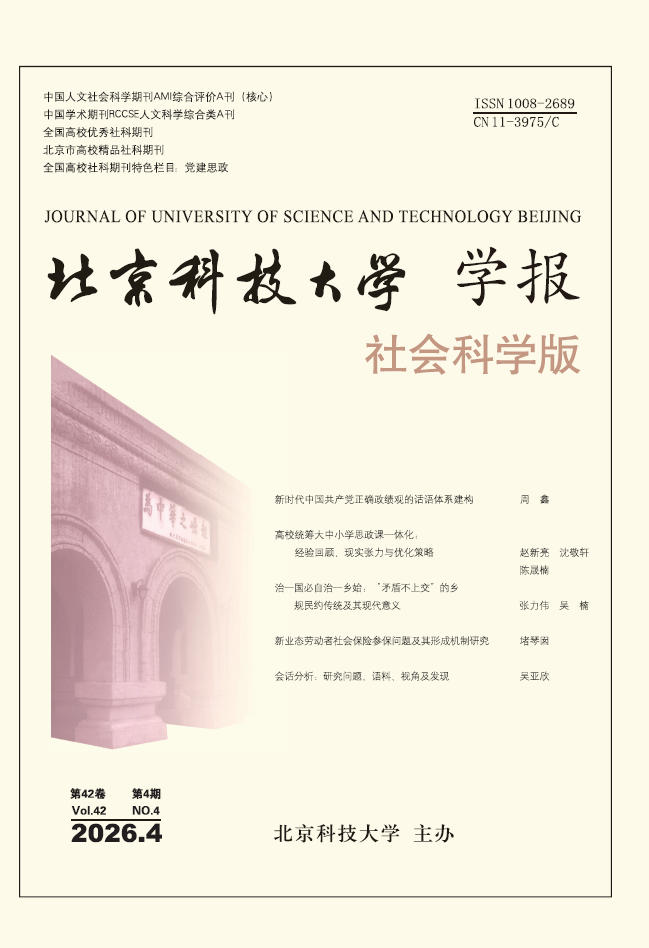
| Citation: | Zhang Liwei, Wu Nan. Governance of a Nation Must Begin at the Village Level: The Tradition of “Not Passing Conflicts Upward” in Rural Codes and Conventions and Its Modern Significance[J]. Journal of University of Science and Technology Beijing ( Social Sciences Edition), 2026, 42(4): 77-86. doi: 10.19979/j.cnki.issn10082689.2025110010

|

| [1] |
张力伟. 基层矛盾在地化解: 历史传统、现实指向与治理价值[J]. 政治学研究, 2025(1): 135-147, 190-191.
|
| [2] |
习近平. 习近平谈治国理政: 第2卷[M]. 北京: 外文出版社, 2017.
|
| [3] |
张明新. 乡规民约存在形态刍论[J]. 南京大学学报(哲学·人文科学·社会科学版), 2004(5): 58-66. doi: 10.3969/j.issn.1007-7278.2004.05.011
|
| [4] |
吴晓玲, 张杨. 论乡规民约的发展及其演变[J]. 广西社会科学, 2012(8): 75-78. doi: 10.3969/j.issn.1004-6917.2012.08.018
|
| [5] |
强世功. “法律不入之地”的民事调解——一起“依法收贷”案的再分析[J]. 比较法研究, 1998(3): 47-59.
|
| [6] |
陈寒非, 高其才. 乡规民约在乡村治理中的积极作用实证研究[J]. 清华法学, 2018, 12(1): 62-88.
|
| [7] |
黄晗. 乡规民约之治: 理论内涵与实践路径[J]. 新视野, 2025(4): 56-65. doi: 10.3969/j.issn.1006-0138.2025.04.006
|
| [8] |
陈明. 中国村民自治的返本开新[J]. 开放时代, 2025(2): 11-12, 188-201.
|
| [9] |
王露璐. 伦理视角下中国乡村社会变迁中的“礼”与“法”[J]. 中国社会科学, 2015(7): 94-107.
|
| [10] |
卞利. 明清徽州族规家法选编[M]. 合肥: 黄山书社, 2014.
|
| [11] |
朱熹. 朱熹集[M]. 四川: 四川教育出版社, 1996.
|
| [12] |
费孝通. 乡土中国[M]. 上海: 上海人民出版社, 2006.
|
| [13] |
周家明, 刘祖云. 传统乡规民约何以可能——兼论乡规民约治理的条件[J]. 民俗研究, 2013(5): 65-70.
|
| [14] |
司春燕. 城乡一体化进程中国家法与民间法的冲突与协调[J]. 前沿, 2010(7): 74-78. doi: 10.3969/j.issn.1671-1750.2011.01.006
|
| [15] |
张英魁, 徐彩勤. 中国乡村精英群体的赋权机制与治理功能[J]. 华南农业大学学报(社会科学版), 2022(4): 104-116. doi: 10.7671/j.issn.1672-0202.2022.04.010
|
| [16] |
牛铭实. 中国历代乡规民约[M]. 北京: 中国社会出版社, 2014.
|
| [17] |
费成康. 中国家族法规[M]. 上海: 上海社会科学院出版社, 2016.
|
| [18] |
王兴亚, 编. 清代河南碑刻资料[M]. 北京: 商务印书馆, 2016.
|
| [19] |
贺海仁. 论无讼文明[J]. 政治与法律, 2025(2): 18-33.
|
| [20] |
论语[M]. 刘胜利, 译. 北京: 中华书局, 2006.
|
| [21] |
张晋藩. 中国古代民事诉讼制度[M]. 北京: 中国法制出版社, 2018.
|
| [22] |
严红. 熟人社会、面子与村庄公共性再生产[J]. 华南农业大学学报(社会科学版), 2023, 22(4): 118-129. doi: 10.7671/j.issn.1672-0202.2023.04.011
|
| [23] |
董磊明, 郭俊霞. 乡土社会中的面子观与乡村治理[J]. 中国社会科学, 2017(8): 147-160.
|
| [24] |
党晓虹, 刘新民. 传承与超越: 传统乡规民约融入乡村治理现代化探究[J]. 农业考古, 2022(4): 125-133.
|
| [25] |
习近平. 在纪念孔子诞辰2565周年国际学术研讨会暨国际儒学联合会第五届会员大会开幕会上的讲话[N]. 人民日报, 2014-09-25(2).
|
| [26] |
高艳芳, 黄永林. 论村规民约的德治功能及其当代价值——以建立“三治结合”的乡村治理体系为视角[J]. 社会主义研究, 2019(2): 102-109.
|
| [27] |
何植民, 蔡静. 嵌入到共生: 乡村振兴视域下新乡贤参与乡村治理的发展图景[J]. 学术界, 2022(7): 134-144. doi: 10.3969/j.issn.1002-1698.2022.07.013
|
| [28] |
郑军庆, 徐娴. 新时代中国共产党指导思想的创新发展与时代价值[J]. 北京科技大学学报(社会科学版), 2025, 41(4): 9-16. doi: 10.19979/j.cnki.issn10082689.2024100132
|
Copyright © Journal of Univeraity of Science and Technology Beijing.京ICP备13030111号
Address:Room 305, Library, 30 Xueyuan Road, Haidian District, Beijing (100083) website:https://bkds.ustb.edu.cn/ Tel:010-62334089
Supported by:
Beijing Renhe Information Technology Co. Ltd




 DownLoad: