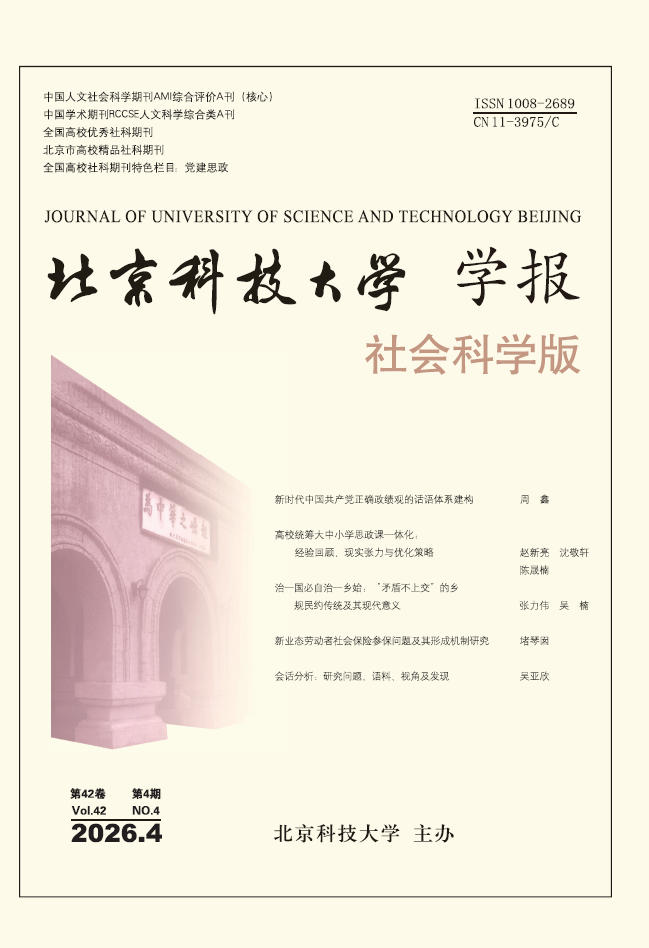
Volume 43 Issue 4
Aug.  2026
Turn off MathJax
Article Contents
Chen Lin. The Spatial Labyrinth of Capital: Spatial Critique and Reflection on Platform Capitalism[J]. Journal of University of Science and Technology Beijing ( Social Sciences Edition), 2026, 42(4): 18-27. doi: 10.19979/j.cnki.issn10082689.2025050052
Citation: Chen Lin. The Spatial Labyrinth of Capital: Spatial Critique and Reflection on Platform Capitalism[J]. Journal of University of Science and Technology Beijing ( Social Sciences Edition), 2026, 42(4): 18-27. doi: 10.19979/j.cnki.issn10082689.2025050052

The Spatial Labyrinth of Capital: Spatial Critique and Reflection on Platform Capitalism

doi: 10.19979/j.cnki.issn10082689.2025050052
  • Received Date: 2025-05-14
    Available Online: 2026-05-15
  • Publish Date: 2026-08-01
  • As a capitalist economic model emerging in the digital era, platform capitalism organizes production activities centered on digital platforms, reshaping the traditional economic structure and spatial order. Relying on the systematic coupling of algorithmic architecture and platform manipulation, platform capitalism anchors users’ subjective consciousness within the spatial maze meticulously constructed by capital. In the production sphere, platform capitalism converts users’ traces in digital space into commodified data flows through algorithmic technologies, thereby establishing a concealed system of digital exploitation that gives rise to unjust contradictions and conflicts in the production process. In the political sphere, digital space has evolved into a crucial arena for power contests, where diverse political forces engage in multi-dimensional games through algorithmic manipulation and behavioral discipline, forging an interest-oriented operational order of digital space that erodes the autonomy of digital space. In view of this, it is imperative to carry out corrective measures in terms of the value rationality of digital technology development, the standardized operation of power in digital space, and the public attribute of fluid digital space. This will promote the paradigm shift of digital space development toward digital justice and, under the guidance of “platform socialism”, explore transformative paths that transcend the underlying logic of platform capitalism.


  • loading
  • [1]
    亨利·列斐伏尔. 空间的生产[M]. 刘怀玉, 译. 北京: 商务印书馆, 2022.
    [2]
    马克思, 恩格斯. 马克思恩格斯全集: 第46卷[M]. 北京: 人民出版社, 2003.
    [3]
    马克思, 恩格斯. 马克思恩格斯全集: 第30卷[M]. 北京: 人民出版社, 1995.
    [4]
    尼克·斯尔尼塞克. 平台资本主义[M]. 程水英, 译. 广州: 广东人民出版社, 2018.
    [5]
    马克思, 恩格斯. 马克思恩格斯全集: 第42卷[M]. 北京: 人民出版社, 2016.
    [6]
    马克思, 恩格斯. 马克思恩格斯文集: 第2卷[M]. 北京: 人民出版社, 2009.
    [7]
    尼尔·史密斯. 不平衡发展: 自然、资本与空间的生产[M]. 刘怀玉, 付清松, 译. 北京: 商务印书馆, 2023.
    [8]
    爱德华·W. 苏贾. 寻求空间正义[M]. 高春花, 强乃社, 陈伟功, 等, 译. 北京: 社会科学文献出版社, 2016.
    [9]
    莎伦·佐金. 裸城: 原真性城市场所的生与死[M]. 丘兆达, 刘蔚, 译. 上海: 上海人民出版社, 2015.
    [10]
    亨利·列斐伏尔. 空间与政治[M]. 李春, 译. 上海: 上海人民出版社, 2015.
    [11]
    理查德·西摩. 推特机器: 为何我们无法摆脱社交媒体?[M]. 王伯笛, 译. 上海: 上海文艺出版社, 2022.
    [12]
    大卫·哈维. 新帝国主义[M]. 初立忠, 沈晓雷, 译. 北京: 社会科学文献出版社, 2009.
    [13]
    爱德华·W. 苏贾. 后现代地理学[M]. 王文斌, 译. 北京: 商务印书馆, 2004.
    [14]
    张新朋, 刘利. 唯物史观视阈下“理性工具化”问题探析[J]. 北京科技大学学报(社会科学版), 2025, 41(1): 111-119. doi: 10.19979/j.cnki.issn10082689.2023090062
    [15]
    褚尔康. 算法秩序的属性、价值与运行[J]. 江海学刊, 2024(6): 160-168, 256. doi: 10.3969/j.issn.1000-856X.2024.06.024
    [16]
    付文军. 《资本论》的空间批判叙事及其社会历史意义[J]. 马克思主义研究, 2024(8): 131-140, 156.
    [17]
    曼纽尔·卡斯特. 网络社会的崛起[M]. 夏铸九, 王志弘, 译. 北京: 社会科学文献出版社, 2001.
    [18]
    邹诗鹏. 卡斯特“流动的空间”概念及其评述[J]. 当代国外马克思主义评论, 2020(3): 199-218.
  • 加载中

Catalog

    通讯作者: 陈斌, bchen63@163.com
    • 1. 

      沈阳化工大学材料科学与工程学院 沈阳 110142

    1. 本站搜索
    2. 百度学术搜索
    3. 万方数据库搜索
    4. CNKI搜索

    Article Metrics

    Article views (0) PDF downloads(0) Cited by()
    Proportional views
    Related

    /

    DownLoad:  Full-Size Img  PowerPoint
    Return
    Return